Puttygen is the SSH key generation tool for the linux version of PuTTY. It works similarly to the ssh-keygen tool in OpenSSH. The basic function is to create public and private key pairs. PuTTY stores keys in its own format in.ppk files. However, the tool can also convert key formats. SSH keys offer a highly secure manner of logging into a server with SSH as against mere dependence on a password. While a password stands the risk of being finally cracked, SSH keys are rather impossible to decipher using brute force. Jun 22, 2012 SSH keys provide a more secure way of logging into a server with SSH than using a password alone. While a password can eventually be cracked with a brute force attack, SSH keys are nearly impossible to decipher by brute force alone. Generating a key pair provides you with two long string of characters: a public and a private key. Save the text file in the same folder where you saved the private key, using the.pub extension to indicate that the file contains a public key. If you or others are going to use an SSH client that requires the OpenSSH format for private keys (such as the ssh utility on Linux), export the private key: On the Conversions menu, choose Export. You can generate an SSH key pair directly in cPanel, or you can generate the keys yourself and just upload the public one in cPanel to use with your hosting account. When generating SSH keys yourself under Linux, you can use the ssh-keygen command. To do so follow these steps: Open up the Terminal; Type in the following command.
-->This article describes ways to generate and use secure shell (SSH) keys on a Windows computer to create and connect to a Linux virtual machine (VM) in Azure. To use SSH keys from a Linux or macOS client, see the quick or detailed guidance.
Overview of SSH and keys
SSH is an encrypted connection protocol that allows secure sign-ins over unsecured connections. SSH is the default connection protocol for Linux VMs hosted in Azure. Although SSH itself provides an encrypted connection, using passwords with SSH connections still leaves the VM vulnerable to brute-force attacks or guessing of passwords. A more secure and preferred method of connecting to a VM using SSH is by using a public-private key pair, also known as SSH keys.
The public key is placed on your Linux VM, or any other service that you wish to use with public-key cryptography.
The private key remains on your local system. Protect this private key. Do not share it.
When you use an SSH client to connect to your Linux VM (which has the public key), the remote VM tests the client to make sure it possesses the private key. If the client has the private key, it's granted access to the VM.
Depending on your organization's security policies, you can reuse a single public-private key pair to access multiple Azure VMs and services. You do not need a separate pair of keys for each VM or service you wish to access.
Your public key can be shared with anyone, but only you (or your local security infrastructure) should possess your private key.
Supported SSH key formats
Azure currently supports SSH protocol 2 (SSH-2) RSA public-private key pairs with a minimum length of 2048 bits. Other key formats such as ED25519 and ECDSA are not supported.
Windows packages and SSH clients
You connect to and manage Linux VMs in Azure using an SSH client. Computers running Linux or macOS usually have a suite of SSH commands to generate and manage SSH keys and to make SSH connections.
Windows computers do not always have comparable SSH commands installed. Recent versions of Windows 10 provide OpenSSH client commands to create and manage SSH keys and make SSH connections from a command prompt. Recent Windows 10 versions also include the Windows Subsystem for Linux to run and access utilities such as an SSH client natively within a Bash shell.
Other common Windows SSH clients you can install locally are included in the following packages:
You can also use the SSH utilities available in Bash in the Azure Cloud Shell.
- Access Cloud Shell in your web browser at https://shell.azure.com or in the Azure portal.
- Access Cloud Shell as a terminal from within Visual Studio Code by installing the Azure Account extension.
Create an SSH key pair
The following sections describe two options to create an SSH key pair on Windows. You can use a shell command (ssh-keygen) or a GUI tool (PuTTYgen). Also note, when using Powershell to create a key, upload the public key as ssh.com(SECSH) format. When using CLI, convert the key into OpenSSH format prior to uploading.
Create SSH keys with ssh-keygen
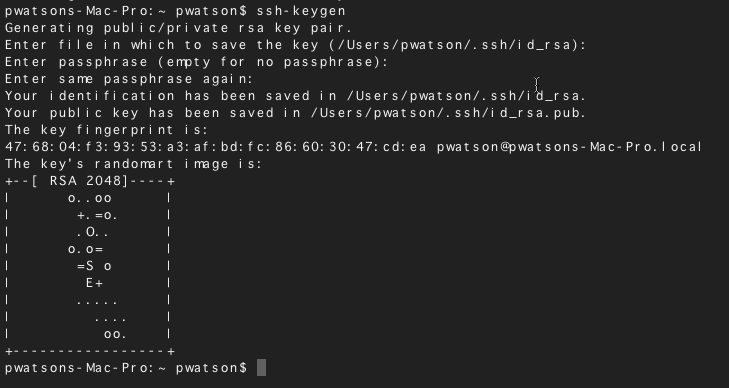
If you run a command shell on Windows that supports SSH client tools (or you use Azure Cloud Shell), create an SSH key pair using the ssh-keygen command. Type the following command, and answer the prompts. If an SSH key pair exists in the chosen location, those files are overwritten.
For more background and information, see the quick or detailed steps to create SSH keys using ssh-keygen.
Create SSH keys with PuTTYgen
If you prefer to use a GUI-based tool to create SSH keys, you can use the PuTTYgen key generator, included with the PuTTY download package.
To create an SSH RSA key pair with PuTTYgen:
Start PuTTYgen.
Click Generate. By default PuTTYgen generates a 2048-bit SSH-2 RSA key.
Move the mouse around in the blank area to provide randomness for the key.
After the public key is generated, optionally enter and confirm a passphrase. You will be prompted for the passphrase when you authenticate to the VM with your private SSH key. Without a passphrase, if someone obtains your private key, they can sign in to any VM or service that uses that key. We recommend you create a passphrase. However, if you forget the passphrase, there is no way to recover it.
The public key is displayed at the top of the window. You can copy this entire public key and then paste it into the Azure portal or an Azure Resource Manager template when you create a Linux VM. You can also select Save public key to save a copy to your computer:
Optionally, to save the private key in PuTTy private key format (.ppk file), select Save private key. You will need the .ppk file later to use PuTTY to make an SSH connection to the VM.
If you want to save the private key in the OpenSSH format, the private key format used by many SSH clients, select Conversions > Export OpenSSH key.

Provide an SSH public key when deploying a VM
To create a Linux VM that uses SSH keys for authentication, provide your SSH public key when creating the VM using the Azure portal or other methods.
The following example shows how you would copy and paste this public key into the Azure portal when you create a Linux VM. The public key is typically then stored in the ~/.ssh/authorized_key directory on your new VM.
Connect to your VM
One way to make an SSH connection to your Linux VM from Windows is to use an SSH client. This is the preferred method if you have an SSH client installed on your Windows system, or if you use the SSH tools in Bash in Azure Cloud Shell. If you prefer a GUI-based tool, you can connect with PuTTY.
Use an SSH client
With the public key deployed on your Azure VM, and the private key on your local system, SSH to your VM using the IP address or DNS name of your VM. Replace azureuser and myvm.westus.cloudapp.azure.com in the following command with the administrator user name and the fully qualified domain name (or IP address):
If you configured a passphrase when you created your key pair, enter the passphrase when prompted during the sign-in process.
If the VM is using the just-in-time access policy, you need to request access before you can connect to the VM. For more information about the just-in-time policy, see Manage virtual machine access using the just in time policy.
Connect with PuTTY
If you installed the PuTTY download package and previously generated a PuTTY private key (.ppk) file, you can connect to a Linux VM with PuTTY.
Start PuTTy.
Fill in the host name or IP address of your VM from the Azure portal:
Select the Connection > SSH > Auth category. Browse to and select your PuTTY private key (.ppk file):
Click Open to connect to your VM.
Next steps
For detailed steps, options, and advanced examples of working with SSH keys, see Detailed steps to create SSH key pairs.
You can also use PowerShell in Azure Cloud Shell to generate SSH keys and make SSH connections to Linux VMs. See the PowerShell quickstart.
If you have difficulty using SSH to connect to your Linux VMs, see Troubleshoot SSH connections to an Azure Linux VM.
This page explains a public key and shows you how to set up SSH keys on a Linux or Unix-like server. I am assuming that you are using Linux or Unix-like server and client with the following software:
Advertisements
- OpenSSH SSHD server
- OpenSSH ssh client and friends on Linux (Ubuntu, Debian, {Free,Open,Net}BSD, RHEL, CentOS, MacOS/OSX, AIX, HP-UX and co).
What is a public key authentication?
Ssh Key Generation In Linux Version
OpenSSH server supports various authentication schema. The two most popular are as follows:
- Passwords based authentication
- Public key based authentication. It is an alternative security method to using passwords. This method is recommended on a VPS, cloud, dedicated or even home based server.
How to set up SSH keys
Steps to setup secure ssh keys:
Create Ssh Key Windows 10
- Create the ssh key pair using ssh-keygen command.
- Copy and install the public ssh key using ssh-copy-id command on a Linux or Unix server.
- Add yourself to sudo or wheel group admin account.
- Disable the password login for root account.
- Test your password less ssh keys login using ssh user@server-name command.
Let us see all steps in details.
How do I set up public key authentication?
You must generate both a public and a private key pair. For example:
Where,
- server1.cyberciti.biz – You store your public key on the remote hosts and you have an accounts on this Linux/Unix based server.
- client1.cyberciti.biz – Your private key stays on the desktop/laptop/ computer (or local server) you use to connect to server1.cyberciti.biz server. Do not share or give your private file to anyone.
In public key based method you can log into remote hosts and server, and transfer files to them, without using your account passwords. Feel free to replace server1.cyberciti.biz and client1.cyberciti.biz names with your actual setup. Enough talk, let’s set up public key authentication. Open the Terminal and type following commands if .ssh directory does not exists:
1: Create the key pair
On the computer (such as client1.cyberciti.biz), generate a key pair for the protocol.
Sample outputs:
You need to set the Key Pair location and name. I recommend you use the default location if you do not yet have another key there, for example: $HOME/.ssh/id_rsa. You will be prompted to supply a passphrase (password) for your private key. I suggest that you setup a passphrase when prompted. You should see two new files in $HOME/.ssh/ directory:
- $HOME/.ssh/id_rsa– contains your private key.
- $HOME/.ssh/id_rsa.pub – contain your public key.
Optional syntax for advance users
The following syntax specifies the 4096 of bits in the RSA key to creation (default 2048):$ ssh-keygen -t rsa -b 4096 -f ~/.ssh/vps-cloud.web-server.key -C 'My web-server key'
Where,
- -t rsa : Specifies the type of key to create. The possible values are “rsa1” for protocol version 1 and “dsa”, “ecdsa”, “ed25519”, or “rsa” for protocol version 2.
- -b 4096 : Specifies the number of bits in the key to create
- -f ~/.ssh/vps-cloud.web-server.key : Specifies the filename of the key file.
- -C 'My web-server key' : Set a new comment.
2: Install the public key in remote server
Use scp or ssh-copy-id command to copy your public key file (e.g., $HOME/.ssh/id_rsa.pub) to your account on the remote server/host (e.g., nixcraft@server1.cyberciti.biz). To do so, enter the following command on your client1.cyberciti.biz:
OR just copy the public key in remote server as authorized_keys in ~/.ssh/ directory:
A note about appending the public key in remote server
On some system ssh-copy-id command may not be installed, so use the following commands (when prompted provide the password for remote user account called vivek) to install and append the public key:
3: Test it (type command on client1.cyberciti.biz)
The syntax is as follows for the ssh command:
Or copy a text file called foo.txt:
You will be prompted for a passphrase. To get rid of passphrase whenever you log in the remote host, try ssh-agent and ssh-add commands.
What are ssh-agent and ssh-add, and how do I use them?
To get rid of a passphrase for the current session, add a passphrase to ssh-agent and you will not be prompted for it when using ssh or scp/sftp/rsync to connect to hosts with your public key. The syntax is as follows:
Type the ssh-add command to prompt the user for a private key passphrase and adds it to the list maintained by ssh-agent command:
Enter your private key passphrase. Now try again to log into user@server1.cyberciti.biz and you will not be prompted for a password:
One can list public key parameters of all identities with the -L option:ssh-add -L
Deleting all private keys from the ssh-agent can be done with the -D option as follows:ssh-add -D
When you log out kill the ssh agent, run:kill $SSH_AGENT_PID
You can also add something like the below to your shell startup to kill ssh-agent at logout:trap 'kill $SSH_AGENT_PID' 0
4: Disable the password based login on a server
Login to your server, type:
Edit /etc/ssh/sshd_config on server1.cyberciti.biz using a text editor such as nano or vim:
Warning: Make sure you add yourself to sudoers files. Otherwise you will not able to login as root later on. See “How To Add, Delete, and Grant Sudo Privileges to Users on a FreeBSD Server” for more info.
$ sudo vim /etc/ssh/sshd_config
OR directly jump to PermitRootLogin line using a vim text editor:$ sudo vim +/PermitRootLogin /etc/ssh/sshd_config
Find PermitRootLogin and set it as follows:
Save and close the file. I am going to add a user named vivek to sudoers on Ubuntu Linux:# adduser vivek
Finally, reload/restart the sshd server, type command as per your Linux/Unix version:
5: How to add or replace a passphrase for an existing private key?
To to change your passphrase type the following command:ssh-keygen -p
6: How do I backup an existing private/public key?
Just copy files to your backup server or external USB pen/hard drive:
Apr 02, 2020 Windows 10 Product Key Generator is the most essential and useful working tool that is downloaded to deal with the entire Window Activation process. It has critical and impressive highlights, and its stresses or properties upgrade its capacities. Jan 29, 2020 windows 10 pro product key generator is organized solution registering latest outclass operating system.Activate correctly in seconds unlimited resources. Windows 10 professional n product key generator software. Enjoy free windows 10 pro activation key 2020. All files are uploaded by users like you, we can’t guarantee that free windows 10 pro activation key 2020 are up to date. We are not responsible for any illegal actions you do with theses files. Dec 19, 2017 On the other hand, Windows 10 Professional Product Key Generator or windows 10 pro activation key generator is necessary for all version of Windows. Go to the Microsoft Site for Buying windows 10 key generator 2019. The Price of this Product key is almost $199. The best part is that you can purchase windows 10 pro product key for the lifetime. Windows 10 Product Key Generator is the greatest practical tool to activate not registered Windows 10 Pro, Enterprise, Home and other editions. It saves your time to discovery useful or working product keys for 32bit and 64bit windows. It the relief to remove watermark or notice from windows qualities.
How do I protect my ssh keys?
- Always use a strong passphrase.
- Do not share your private keys anywhere online or store in insecure cloud storage.
- Restrict privileges of the account.
How do I create and setup an OpenSSH config file to create shortcuts for servers I frequently access?
See how to create and use an OpenSSH ssh_config file for more info.
Conclusion
This page explained how to set up ssh keys for authentication purposes. For more info see the following resources:
- Man pages – ssh-keygen(1)
- OpenSSH project homepage here.
And, there you have it, ssh set up with public key based authentication for Linux or Unix-like systems.
ADVERTISEMENTS