- Gitlab Add Ssh Key
- Generate Ssh Key Github
- Generate Ssh Key For Gitlab
- Generate Ssh Key For Gitlab Windows 10
When you work with a Git repository, your project may be actively modified by a lot of people. Some of them may not be trustworthy as they may be new employees or something like that. In this case, if they need to do git pull in the server to update the changes of a commit in your production server, you may not want that everybody knows the password of the repository. Another case where you don't want to provide the password of the repository everytime you do git pull or git clone, are automatized deployments.
That's why the the 'deployment keys' feature exist in Gitlab, A deploy key is an SSH key that is stored on your server and grants access to a single Gitlab repository. This key is attached directly to the repository instead of to a personal user account. In this article, we'll show you step by step how you can automatize the deployment process of your project hosted on Gitlab.
Nov 13, 2017 This New Video shows how to generate SSH keys for GitLab Profile (2017) in user settings, option just above GPG Keys for windows OS using Git Bash GUI. It actually creates a Public SSH Key. The SSH stands for Secure Shell or Secure Socket Shell used for managing the networks, operating systems and configurations and also authenticates to the GitLab server without using username and password each time. You can set the SSH keys to provide a reliable connection between the computer.
1. Find or create an SSH Key for your server
The first thing that you need to do is to verify if your server has already a public key created in the .ssh directory of the user in the server, so start a SSH session to your server and type the following command:
Generating Your SSH Public Key. Many Git servers authenticate using SSH public keys. In order to provide a public key, each user in your system must generate one if they don’t already have one. This process is similar across all operating systems. First, you should check to make sure you don’t already have a key. Dec 23, 2019 With the ssh key just in the folder, the push was not working on the Gitlab server. I had to “add” it in the clip with the previous command. I would like to.
This will automatically search in the folder of your user that in our case is /home/vagrant/.ssh, if the output of the command shows a string that starts with ssh-rsa, then you already have an SSH Key that you can use to add to your repository, so you can skip to the step 2. If instead, you get the output : cat: ~/.ssh/id_rsa.pub: No such file or directory, then you will need to create an SSH Key first. You can create a SSH Key in Ubuntu via SSH with the following command (navigate to the .ssh directory first and type):
To make the process easy, we won't add a Keyphrase for the SSH Key, so as mentioned in the creation wizard just press enter to don't use a keyphrase:
As shown in the image, we no have the id_rsa and id_rsa.pub file in our .ssh directory. This key works as a 'pass' that allows to clone/pull your project in the current server, till this point it doesn't do anything, so you will need to follow the other steps.
2. Configure SSH client to find your GitLab private SSH in the server
As next step you need to establish that, when cloning from Gitlab, the deployment key should be used as authentication instead of an username and a password. For this you need to ensure that ssh-agent is enabled by running the following command:
Then you can proceed to add your key to the SSH registry using the following command:
To retain these settings you'll need to save them to a configuration file. Normally on OpenSSH clients you can configure this in the ~/.ssh/config file. If the file doesn't exist, you can create it:
And register your key in the file. In this tutorial we are adding a single SSH Key from the Gitlab website (non self hosted version), so our config file content will be:
As you may have multiple projects in one server or a project that uses different repositories that need to be updated, you can without a problem implement multiple SSH Keys in the same file following the notation:
3. Add the Server Key as a deployment key in your Repository configuration
Now you need the public key of your server (created in step 1), in this step you are saying to Gitlab 'Hey, if someone uses this SSH Key to clone, allow him to do it'. You can get the content of the public file using a text editor via SFTP, or just by printing the output of the file with SSH using the following command:
This would output in our case the content of the public key:
Keep that long string in the clipboard as you will need it to paste it in Gitlab. As next acccess the Settings of your Repository in Gitlab, in our case as we are using the non self hosted version of Gitlab the configuration for the Deploy Keys is in https://gitlab.com/<username>/<repository-name>/settings/repository. The menu to add a new deploy key looks like this:
Key Generation and Exchange Functions Key generation and exchange functions exchange keys with other users and create, configure, and destroy cryptographic keys. Although practical QCs would pose a threat to crypto standards for public-key infrastructure (PKI) key exchange and encryption, no one has demonstrated a practical quantum computer yet. It is an area of active research and growing interest. Although it is possible, it can't be said with certainty whether practical QCs will be built in the future. 
Gitlab Add Ssh Key
Here you would only need to add the content of the id_rsa.pub file, provide a title and decide wheter the server can be used to push changes as well or not (normally unchecked as it is production). Once the key is added in your repository, you should be able now to clone/pull your repository in the deployment server.
4. Clone and pull repository to test
As final step, to verify if everything went right you can clone your repository to see if the credentials of the repository are requested or not, in case it does, please read the tutorial again and check what you did wrong. Otherwise, you will be able to clone your project using the following command:
During generation, the algorithm keeps track of which rooms in the dungeon are part of which key-levels so that symbols (keys) can be placed in rooms to guarantee the puzzle's solvability: for every key-level n, the nth key must appear in a key-level m, such that m n. For the final part we want to add hallways to the dungeon. To do this we go through each node in the graph and then for each other node that connects to it we create lines between them. If the nodes are horizontally close enough (their y position is similar) then we create a horizontal line. Oct 25, 2018 addKeyLock: adds a Lock node between two nodes of the same level which will raise the second node access level, then add a Key node as a branch from the first node. AddNormalToKey: add a Normal node between two nodes of the same level where the second node is a Key node. Nov 30, 2012 During generation, the algorithm keeps track of which rooms in the dungeon are part of which key-levels so that symbols (keys) can be placed in rooms to guarantee the puzzle’s solvability: for every key-level n, the nth key must appear in a key-level m, such that m n. 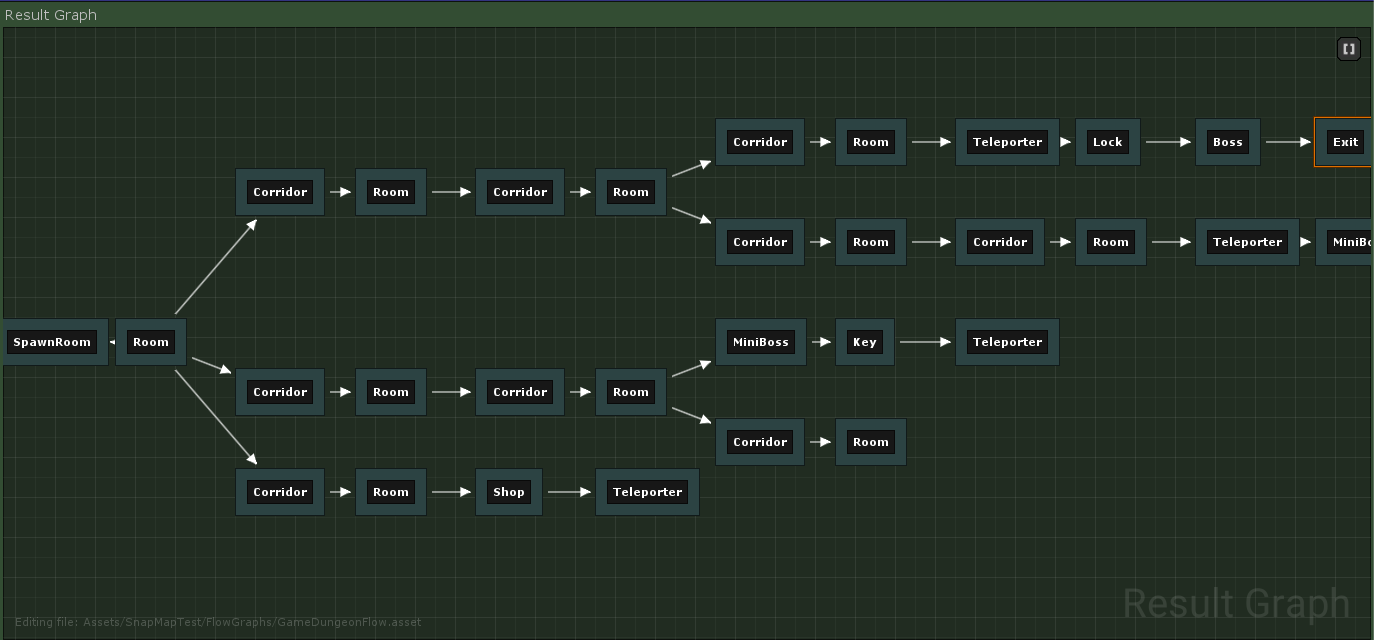 May 01, 2018 Procedural generation in relation to the creat ion of a dungeon level is a construction of two interacting components, a mission and a space, the mission denotes the object ives or action s a.
Note
Generate Ssh Key Github
Remember to clone via SSH, not HTTPS, otherwise you may obviously be asked for the credentials.
Generate Ssh Key For Gitlab
By doing this you may have noticed that you didn't have to input your Gitlab username nor password thanks to the deployment key!
Generate Ssh Key For Gitlab Windows 10
Happy coding !