Generating keys and certificates. How to generate keys and certificates. Set the Generate Key on HSM property to indicate whether to create the key on the HSM. Creates the key on the DataPower Gateway. The file name (URL) for the key has the cert:///name format. In the Using Existing Key Object field. As Zoredache said the entire point of public key cryptography is that you have two parts: A public half (.cert file) which encrypts data, and a private half (.key file) which lets you decrypt it again.The contents of the cert file are given to everyone who connects to your server. It would defeat the purpose of encrypting data if that information were usable to decrypt the traffic too. Generating Keys for Encryption and Decryption.; 3 minutes to read +7; In this article. Creating and managing keys is an important part of the cryptographic process. Symmetric algorithms require the creation of a key and an initialization vector (IV). The key must be kept secret from anyone who should not decrypt your data. Better self-signed certificates. Here's a script that helps you generate self signed certificates. It will generate both a root certificate and a leaf. (The TLS certificates generated by crypto/tls/generatecert.go act both as a CA and as a leaf certificate. Some TLS clients have a problem with that scheme.). What I believe is happening is that apsd is reporting the same thing, but the developers decided to write that in the logs as 'Unrecognized leaf certificate'. Apple should create a new certificate that includes a wildcard (CN (Common Name):.courier.push.apple.com) to correct this issue.
- Generate Leaf Cert From Public Key Largo
- Cert Public Key
- Generate Leaf Cert From Public Key Search
- Generate Leaf Cert From Public Key Work
- Generate Cert Request
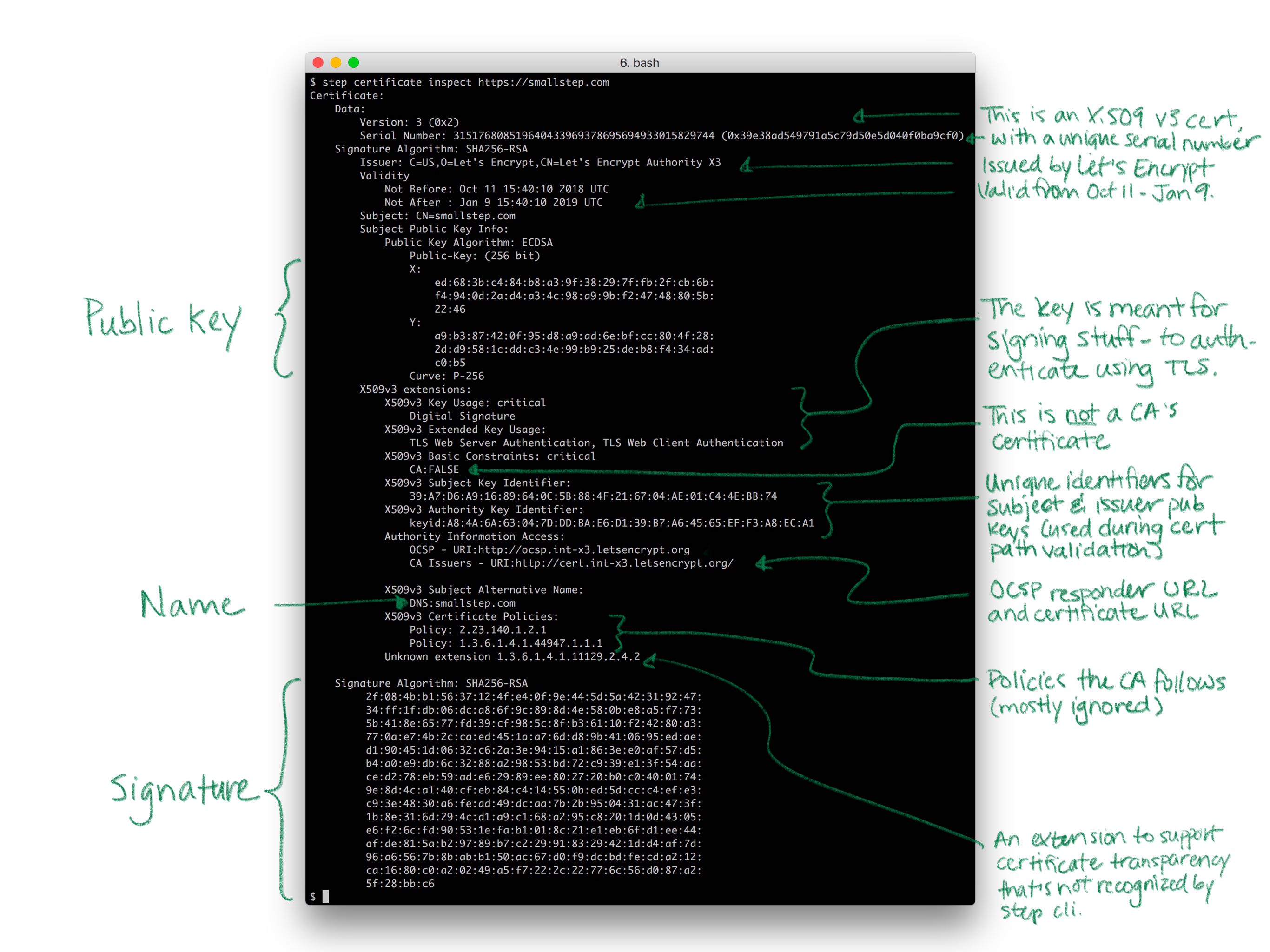
Create the root pair¶ Acting as a certificate authority (CA) means dealing with cryptographic pairs of private keys and public certificates. The very first cryptographic pair we’ll create is the root pair. This consists of the root key (ca.key.pem) and root certificate (ca.cert.pem). This pair forms the identity of.
-->Creating and managing keys is an important part of the cryptographic process. Symmetric algorithms require the creation of a key and an initialization vector (IV). The key must be kept secret from anyone who should not decrypt your data. The IV does not have to be secret, but should be changed for each session. Asymmetric algorithms require the creation of a public key and a private key. The public key can be made public to anyone, while the private key must known only by the party who will decrypt the data encrypted with the public key. This section describes how to generate and manage keys for both symmetric and asymmetric algorithms.
Symmetric Keys
The symmetric encryption classes supplied by the .NET Framework require a key and a new initialization vector (IV) to encrypt and decrypt data. Whenever you create a new instance of one of the managed symmetric cryptographic classes using the parameterless constructor, a new key and IV are automatically created. Anyone that you allow to decrypt your data must possess the same key and IV and use the same algorithm. Generally, a new key and IV should be created for every session, and neither the key nor IV should be stored for use in a later session.
To communicate a symmetric key and IV to a remote party, you would usually encrypt the symmetric key by using asymmetric encryption. Sending the key across an insecure network without encrypting it is unsafe, because anyone who intercepts the key and IV can then decrypt your data. For more information about exchanging data by using encryption, see Creating a Cryptographic Scheme.
The following example shows the creation of a new instance of the TripleDESCryptoServiceProvider class that implements the TripleDES algorithm.
When the previous code is executed, a new key and IV are generated and placed in the Key and IV properties, respectively.
Sometimes you might need to generate multiple keys. In this situation, you can create a new instance of a class that implements a symmetric algorithm and then create a new key and IV by calling the GenerateKey and GenerateIV methods. The following code example illustrates how to create new keys and IVs after a new instance of the symmetric cryptographic class has been made.
When the previous code is executed, a key and IV are generated when the new instance of TripleDESCryptoServiceProvider is made. Another key and IV are created when the GenerateKey and GenerateIV methods are called.
Generate Leaf Cert From Public Key Largo
Asymmetric Keys
The .NET Framework provides the RSACryptoServiceProvider and DSACryptoServiceProvider classes for asymmetric encryption. These classes create a public/private key pair when you use the parameterless constructor to create a new instance. Asymmetric keys can be either stored for use in multiple sessions or generated for one session only. While the public key can be made generally available, the private key should be closely guarded.
A public/private key pair is generated whenever a new instance of an asymmetric algorithm class is created. After a new instance of the class is created, the key information can be extracted using one of two methods:
The ToXmlString method, which returns an XML representation of the key information.
The ExportParameters method, which returns an RSAParameters structure that holds the key information.
Both methods accept a Boolean value that indicates whether to return only the public key information or to return both the public-key and the private-key information. An RSACryptoServiceProvider class can be initialized to the value of an RSAParameters structure by using the ImportParameters method.
Asymmetric private keys should never be stored verbatim or in plain text on the local computer. If you need to store a private key, you should use a key container. For more on how to store a private key in a key container, see How to: Store Asymmetric Keys in a Key Container.
The following code example creates a new instance of the RSACryptoServiceProvider class, creating a public/private key pair, and saves the public key information to an RSAParameters structure.
 Microsoft office 2016 product key generator is a free tool that is used to generate the activation keys for Microsoft office 2016 and make your Microsoft application activated for the lifetime. Though you need to be activation after installation process of Microsoft Office 2016, but you don’t worry, there I am going to introduce a tremendous. Dec 29, 2016 MS Office 2016 Professional Plus is a best product which is developed by Microsoft. The new Microsoft Office 2016 for windows includes updated versions of Word, Excel, PowerPoint, OneNote and Outlook. Microsoft Office 2016 Key are more accurate and working than any activation keys you find from any where. It is easy to use and install.
See also
-->A Key Vault (KV) certificate can be either created or imported into a key vault. When a KV certificate is created the private key is created inside the key vault and never exposed to certificate owner. The following are ways to create a certificate in Key Vault:
Create a self-signed certificate: This will create a public-private key pair and associate it with a certificate. The certificate will be signed by its own key.
Create a new certificate manually: This will create a public-private key pair and generate an X.509 certificate signing request. The signing request can be signed by your registration authority or certification authority. The signed x509 certificate can be merged with the pending key pair to complete the KV certificate in Key Vault. Although this method requires more steps, it does provide you with greater security because the private key is created in and restricted to Key Vault. This is explained in the diagram below.
The following descriptions correspond to the green lettered steps in the preceding diagram.
- In the diagram above, your application is creating a certificate which internally begins by creating a key in your key vault.
- Key Vault returns to your application a Certificate Signing Request (CSR)
- Your application passes the CSR to your chosen CA.
- Your chosen CA responds with an X509 Certificate.
- Your application completes the new certificate creation with a merger of the X509 Certificate from your CA.
- Create a certificate with a known issuer provider: This method requires you to do a one-time task of creating an issuer object. Once an issuer object is created in you key vault, its name can be referenced in the policy of the KV certificate. A request to create such a KV certificate will create a key pair in the vault and communicate with the issuer provider service using the information in the referenced issuer object to get an x509 certificate. The x509 certificate is retrieved from the issuer service and is merged with the key pair to complete the KV certificate creation.
The following descriptions correspond to the green lettered steps in the preceding diagram.
- In the diagram above, your application is creating a certificate which internally begins by creating a key in your key vault.
- Key Vault sends an TLS/SSL Certificate Request to the CA.
- Your application polls, in a loop and wait process, for your Key Vault for certificate completion. The certificate creation is complete when Key Vault receives the CA’s response with x509 certificate.
- The CA responds to Key Vault's TLS/SSL Certificate Request with an TLS/SSL X.509 certificate.
- Your new certificate creation completes with the merger of the TLS/SSL X.509 certificate for the CA.
Asynchronous process
KV certificate creation is an asynchronous process. This operation will create a KV certificate request and return an http status code of 202 (Accepted). The status of the request can be tracked by polling the pending object created by this operation. The full URI of the pending object is returned in the LOCATION header.
Microsoft Office 365 Product Key Generator used for activation of Microsoft Office product full version free. Microsoft Office is the complete product that developed by Microsoft corporation. Microsoft Office 365 Product Key is a complete all-in-one package of tools that support to make office full version to use its all features easily and freely. Apr 11, 2020 Microsoft Office 365 Product Key had Office planner is a brand new office app that can be used in project management, assign a job to the staff, then monitor team develops. Office 365 Pro Plus created when the set of tools to allow for online mail hosting able to safely and quickly accessing corporate networks as well as cloud data storage. Microsoft office 365 product key online generator.
When a request to create a KV certificate completes, the status of the pending object will change to “completed” from “inprogress”, and a new version of the KV certificate will be created. This will become the current version.
First creation
When a KV certificate is created for the first time, an addressable key and secret is also created with the same name as that of the certificate. If the name is already in use, then the operation will fail with an http status code of 409 (conflict).The addressable key and secret get their attributes from the KV certificate attributes. The addressable key and secret created this way are marked as managed keys and secrets, whose lifetime is managed by Key Vault. Managed keys and secrets are read-only. Note: If a KV certificate expires or is disabled, the corresponding key and secret will become inoperable.
If this is the first operation to create a KV certificate then a policy is required. A policy can also be supplied with successive create operations to replace the policy resource. If a policy is not supplied, then the policy resource on the service is used to create a next version of KV certificate. Note that while a request to create a next version is in progress, the current KV certificate, and corresponding addressable key and secret, remain unchanged.
Self-issued certificate
To create a self-issued certificate, set the issuer name as 'Self' in the certificate policy as shown in following snippet from certificate policy.
If the issuer name is not specified, then the issuer name is set to 'Unknown'. When issuer is 'Unknown', the certificate owner will have to manually get a x509 certificate from the issuer of his/her choice, then merge the public x509 certificate with the key vault certificate pending object to complete the certificate creation.
Partnered CA Providers
Cert Public Key
Certificate creation can be completed manually or using a “Self” issuer. Key Vault also partners with certain issuer providers to simplify the creation of certificates. The following types of certificates can be ordered for key vault with these partner issuer providers.
| Provider | Certificate type |
|---|---|
| DigiCert | Key Vault offers OV or EV SSL certificates with DigiCert |
| GlobalSign | Key Vault offers OV or EV SSL certificates with GlobalSign |
A certificate issuer is an entity represented in Azure Key Vault (KV) as a CertificateIssuer resource. It is used to provide information about the source of a KV certificate; issuer name, provider, credentials, and other administrative details.
Generate Leaf Cert From Public Key Search
Note that when an order is placed with the issuer provider, it may honor or override the x509 certificate extensions and certificate validity period based on the type of certificate.
Generate Leaf Cert From Public Key Work
Authorization: Requires the certificates/create permission.